
Native Communities Leading Farm to School

This year, IAC's regional summits highlighted how Farm to School can connect Tribal students with local foods and establish schools as markets for Tribal producers. Farm to School enriches students with educational opportunities about agriculture, foodways, and community health.
In the presentation “Native Communities Leading Farm to School,” Johanna Herron, IAC Portfolio Strategist, and Lillian Hall, IAC Program Coordinator, brought together experts on Farm to School to discuss how schools purchase food, what barriers make local procurement difficult, and why IAC can play a role in connecting producers, schools, Tribes, and technical assistance partners.

During the Southwest Regional Summit, panel experts included Mary Ben, Director of Operations for Bidii Baby Foods & BEN Initiative, and Kyle White, former Program Assistant for the Diné Food Sovereignty Alliance. Mary offered insight on how local producers connect to school buyers or meal planners through Farm to School, detailing Buyer/Producer meetings with discussions on yield, desired produce, timing, and more.
Kyle shared how his work sits at the intersection of agriculture, public health, culture, and community. He saw parallels in how Farm to School strengthened the connection between tradition and what students eat by offering locally grown food.
“Scaling [Farm to School programs] is not only about producing more food or reaching more schools; it is also about building stronger relationships between the producers, schools, families, and communities.
From a business perspective, Farm to School can give Native farmers and local producers a more consistent market for what they grow. Schools are feeding students every day. That creates more dependable opportunities for producers while keeping more food dollars within the community.
For the end user, especially the students, scaling up can mean greater access to fresh foods— local and culturally relevant foods. Food education is also connected to culture and stories, land and identity. In the scale of these programs, we should also scale our cultural education that comes with the food in and of itself.”— Kyle White, Former Program Assistant, Diné Food Sovereignty Alliance
At the Rocky Mountain Regional Summit, the panel included KayAnn Miller, Co-Executive Director of the Montana Partnership to End Childhood Hunger Inc.; Joanna Studt, former Farm to School Program Coordinator of the Cheyenne River Sioux Tribe Buffalo Authority Corporation; and Debe Brady, former School Nutrition Director for Belgrade School District #44. Together, they covered perspectives from school food service, state agency Farm to School programs, and the Montana Partnership to End Childhood Hunger. The Montana team shared its partnership in developing an Indigenous recipe book designed to help schools incorporate Indigenous foods into school meal programs and nutrition education.
Overall, Tribal producers shared a strong interest in school market opportunities and their potential to drive business growth and strengthen local food systems. Participants also discussed a growing demand for producer connections, procurement navigation, and specialized technical assistance.
Even in states with strong agricultural industries, getting locally produced foods into schools can be a challenge. These panels and the discussions that followed offered encouragement and practical insights for producers looking to get involved in Farm to School programs.
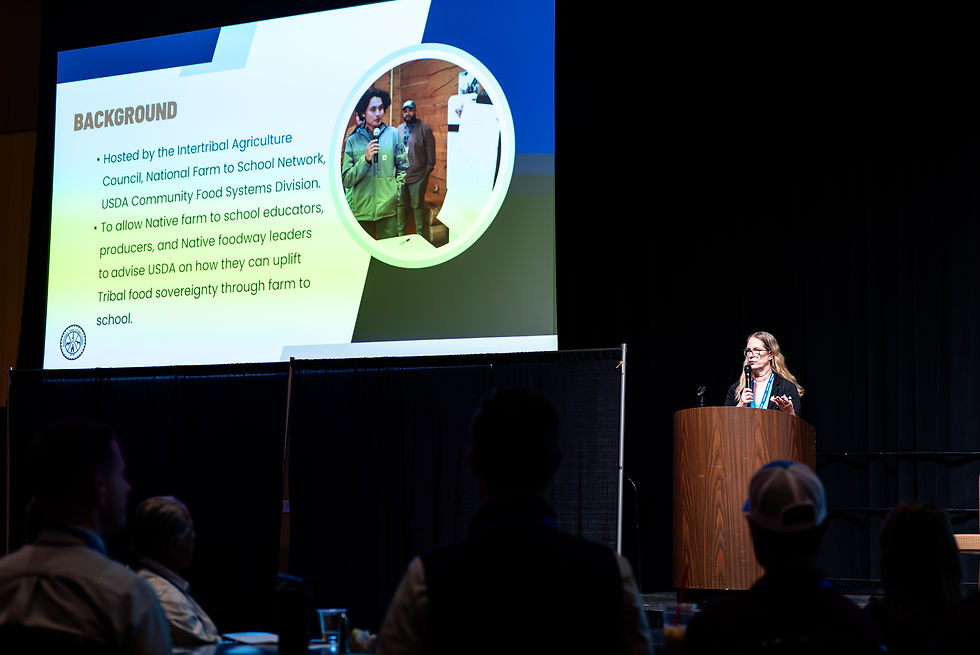
“While you might not have Farm to School in your community, a great start is to hear what others are doing successfully. So that the ideas you get from existing Farm to School efforts can be applied to your own situation,” said Johanna Herron.
Building community to solve these issues is exactly why IAC hosts regional summits to expand on and improve local food access across Indian Country.


